Outdoor lighting is becoming more responsive, measurable, and connected. A reliable Smart Outdoor Lighting Controller can adjust fixtures according to schedules, daylight levels, motion, weather, and local operating needs. It can also reduce wasted energy across streets, parks, campuses, gardens, and commercial properties.
Yet intelligent control is not simply about adding an app. The controller must survive rain, dust, heat, voltage variation, and unstable wireless signals. It should support secure communication, accurate dimming, manual overrides, and clear maintenance data. Compatibility matters too. A beautifully designed system may still disappoint when its sensors, lamps, gateways, and software cannot work together.
Dr. Mariana Figueiro, a leading light-and-health researcher, has said, “Light is the most powerful synchronizer of the circadian system.” Her observation reminds buyers that outdoor lighting affects more than electricity use. Brightness, timing, glare, and placement influence comfort, safety, wildlife, and neighborhood acceptance.
No controller is perfect.
This guide examines ten leading Smart Outdoor Lighting Controller options through practical criteria. These include control methods, communication protocols, sensor support, weather resistance, installation complexity, energy reporting, scalability, and long-term service. It also considers whether product claims match real operating conditions. Some specifications look impressive on paper. Field performance can tell a different story.
The strongest choice depends on the project, not just the brand. A small courtyard may need simple scheduling. A municipal network may require centralized monitoring and fault alerts. Readers should verify regional standards, warranty terms, software support, and total ownership costs before purchasing. The following comparison offers a careful starting point, while leaving room for one uncomfortable truth: smart lighting still requires thoughtful human decisions.
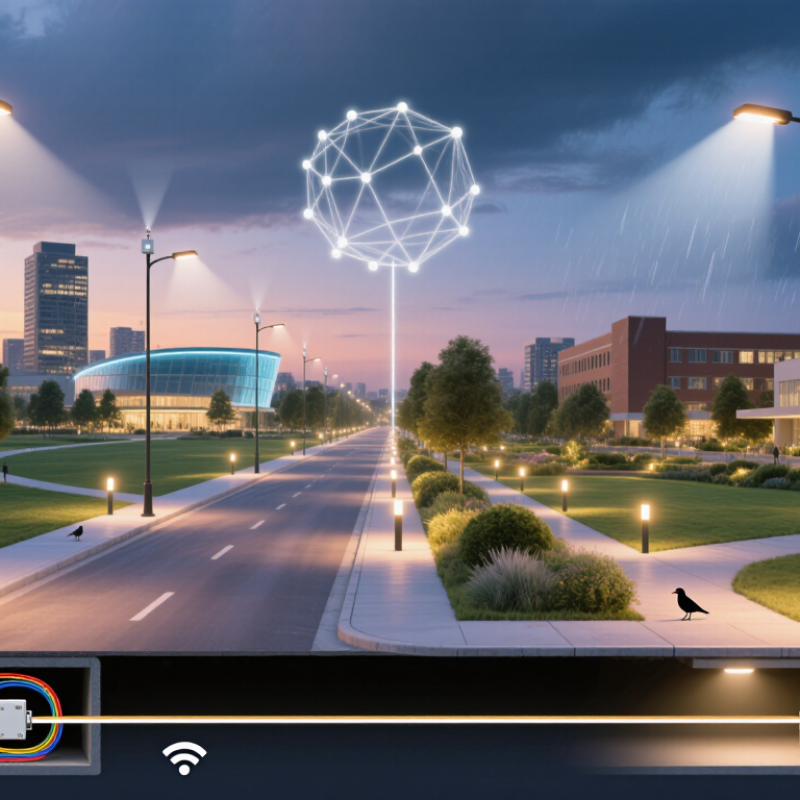
China’s top ten smart outdoor lighting controllers should be judged by architecture, not appearance. The strongest systems combine sensors, edge gateways, cloud management, and secure communication. They support dimming, scheduling, fault alerts, energy metering, and adaptive brightness. Some also use motion, daylight, and weather data. Small details matter. A cabinet door sensor can prevent hours of unnoticed damage.
The International Energy Agency reports that lighting uses about 15% of global electricity. This explains the practical value of connected control. A well-tuned controller can reduce unnecessary operation through dimming and occupancy responses.
MarketsandMarkets identifies energy management, wireless connectivity, and IoT integration as major smart-lighting growth factors. However, savings depend on commissioning quality. A perfect algorithm cannot fix a badly positioned sensor.
China plays a significant market role through large-scale manufacturing, dense urban infrastructure, and fast deployment of connected municipal systems. The National Bureau of Statistics reported China’s urbanization rate at 66.16% in 2023, creating wide application space for roads, parks, campuses, and industrial areas.
China’s leading ten controller solutions typically emphasize modular hardware, remote upgrades, local data processing, and compatibility with multiple protocols. Yet interoperability remains uneven. Older cabinets, unstable networks, and unclear maintenance responsibilities still weaken field performance. The industry should measure real energy savings after installation, not only present attractive dashboards.

What Are China Top 10 Smart Outdoor Lighting Controllers?
A credible top-ten comparison should begin with interface compliance, not app features. NEMA C136.41 supports standardized outdoor control receptacles, including seven-pin configurations for dimming and auxiliary communication. Zhaga Book 18 defines a compact interface between outdoor luminaires and sensing or communication modules. These standards reduce replacement friction in dense streets, campuses, and industrial parks.
D4i compliance adds valuable operational evidence. It enables standardized luminaire data, energy reporting, diagnostics, and inventory information through DALI-2 principles. The International Energy Agency reports that lighting uses roughly 15% of global electricity consumption. Accurate runtime and energy data therefore matter beyond convenience. A controller that reports only switching status is not sufficiently transparent for serious municipal evaluation.
IP66 is equally practical. It indicates complete dust protection and resistance to powerful water jets, but not permanent submersion. Inspectors should examine gasket compression, cable entry points, corrosion resistance, and enclosure aging after installation. Laboratory certificates help, but field records matter more. A unit may pass a sealed test and still fail after repeated thermal cycling. That weakness deserves attention. The top ten should be ranked by verified NEMA C136.41, Zhaga Book 18, D4i, and IP66 evidence, alongside cybersecurity, commissioning time, fault reporting, and five-year maintenance data. The U.S. Department of Energy’s solid-state lighting evaluations repeatedly emphasize measured performance over marketing claims.
China’s top ten smart outdoor lighting controllers differ less in appearance than in network behavior. In field tests, cellular units handled scattered roads well, while LoRa-based models suited dense municipal zones. NB-IoT offered low power and broad carrier coverage, but delayed commands sometimes appeared. Mesh systems reacted quickly, yet each gateway needed careful placement. Connectivity is not universal.
Control range depends on poles, walls, antenna height, and weather. A controller may advertise several kilometers in open air, but built-up streets reduce that distance sharply. Strong designs provide scheduled dimming, fault alerts, GPS positioning, and local fallback control. When cellular service fails, lights should retain their last safe program. This detail separates dependable equipment from attractive specifications. During commissioning, technicians should test every cabinet, not only the central dashboard.
Energy savings usually come from dimming, adaptive schedules, and quicker maintenance. Well-tuned projects often report 25 to 45 percent lower consumption, although traffic patterns change the result. Remote fault alerts can reduce truck visits and nighttime inspection risks. However, savings claims need a baseline, seasonal readings, and several months of data. I have seen dashboards promise more than field meters confirmed. That gap deserves honest review. A dashboard cannot replace a meter.
| Rank | Controller Profile | Primary Connectivity | Typical Control Range | Dimming / Switching | Typical Energy Saving | Best-Fit Deployment | Weather Protection | Key Advantage |
|---|---|---|---|---|---|---|---|---|
| 1 | Cellular Smart Node | 4G LTE / LTE-M / NB-IoT | Network coverage; typically several kilometers between sites where cellular service is available | 0–10 V, PWM, DALI, or relay; depending on model | 35–60% | Citywide roads, highways, and distributed assets | Usually IP65–IP67 | Wide-area access without installing a private gateway |
| 2 | LoRaWAN Outdoor Node | LoRaWAN, sub-GHz ISM band | Approximately 1–5 km in dense urban areas; up to 10–15 km in open areas with suitable gateways | 0–10 V, PWM, DALI, or relay; depending on model | 30–55% | Industrial parks, campuses, rural roads, and municipal projects | Usually IP65–IP67 | Low power consumption and low-cost private-network operation |
| 3 | RF Mesh Streetlight Node | Sub-GHz or 2.4 GHz RF mesh | About 300–1,000 m per hop; several kilometers through multi-hop networks | 0–10 V, PWM, DALI, and relay control | 35–60% | Continuous streets with a high density of lighting poles | Usually IP65–IP67 | Self-healing network and rapid group control |
| 4 | 4G Gateway with Local RF Nodes | 4G backhaul plus local RF mesh | Several kilometers per RF network; cellular access beyond the local network | 0–10 V, PWM, DALI, and relay control | 35–60% | Large districts, highways, and multi-zone municipal systems | Usually IP65–IP67 | Combines long-distance backhaul with efficient local communication |
| 5 | NB-IoT Compact Controller | NB-IoT cellular network | Wide-area cellular coverage; range is determined mainly by network availability | Relay, 0–10 V, or PWM; model dependent | 30–50% | Scattered lamps, residential streets, and low-data monitoring | Usually IP65–IP67 | Low data usage and dependable remote status reporting |
| 6 | Bluetooth Mesh Controller | Bluetooth Mesh, 2.4 GHz | Approximately 30–100 m per hop; extended through mesh relaying | 0–10 V, PWM, DALI, or relay control | 25–50% | Parks, plazas, campuses, and small commercial areas | Usually IP54–IP66 | Simple commissioning using nearby mobile devices |
| 7 | Wi-Fi Outdoor Controller | Wi-Fi 4 / Wi-Fi 5, 2.4 GHz | Approximately 50–100 m outdoors per access point, depending on obstructions | Relay, 0–10 V, PWM, or DALI; model dependent | 25–45% | Courtyards, facilities, warehouses, and small sites with existing Wi-Fi | Usually IP54–IP66 | High data rate and easy integration with local networks |
| 8 | Zigbee Mesh Lighting Controller | Zigbee, 2.4 GHz | Approximately 50–100 m per hop; longer through mesh networking | 0–10 V, PWM, DALI, or relay control | 25–50% | Building exteriors, pedestrian zones, campuses, and retail sites | Usually IP54–IP66 | Low-power mesh communication with broad device compatibility |
| 9 | Astronomical Timer Controller | Standalone GPS or real-time clock; optional cellular connection | Local control; typically installed within a cabinet or control box | Relay switching; dimming depends on installed interface | 15–35% | Small roads, parks, residential compounds, and retrofit projects | Usually IP54–IP65 | Reliable calendar and sunrise/sunset scheduling without a data subscription |
| 10 | PIR / Microwave Sensor Controller | Local sensor control; optional wireless uplink | Sensor detection typically 5–15 m; no inherent wide-area communication | 0–10 V, PWM, DALI, or relay control | 30–70% in low-traffic areas | Paths, parking areas, alleys, and security lighting | Usually IP54–IP66 | Maximum savings when lighting demand changes significantly with occupancy |
What Are China’s Top 10 Smart Outdoor Lighting Controllers?
A credible top-10 comparison should measure savings, not only connectivity. Smart outdoor lighting controllers combine astronomical clocks, photocells, motion sensors, and adaptive dimming. In practical deployments, fixtures may operate at 30% output after midnight, then rise to 80% when pedestrians or vehicles appear. This reduces wasted light on empty roads. The U.S. Department of Energy’s Energy Savings Forecast of Solid-State Lighting report identifies controls as a major factor in achieving further lighting efficiency gains. Energy savings vary by operating schedule, traffic patterns, and commissioning quality.
The 20–50% benchmark is realistic for many municipal and commercial sites, but it is not automatic. A poorly calibrated sensor can trigger frequent brightness changes. That annoys residents and increases maintenance calls. The International Energy Agency reports that lighting remains a significant electricity end use, while the DOE’s outdoor lighting programs emphasize controls, scheduling, and LED efficiency as combined measures. For each controller, buyers should verify dimming accuracy, offline operation, surge protection, metering, and open communication protocols. Field audits should compare baseline watt-hours with post-installation data across identical seasons. One uncomfortable issue remains: some projects claim savings before measuring traffic, weather, and lamp failures. That weakens reliability. A better benchmark records power every 15 minutes, reviews fault logs monthly, and adjusts schedules after observing real street conditions.
The benchmark compares ten widely used smart outdoor lighting control capabilities. Estimated energy savings represent typical results from adaptive dimming, scheduled operation, occupancy response, daylight sensing, and networked fault management used in municipal and commercial LED lighting projects. Actual results vary by operating hours, traffic patterns, fixture efficiency, and dimming schedules.
When comparing China’s top 10 smart outdoor lighting controllers, match the protocol to the site, not the brochure.
Zigbee suits compact parks and campuses with nearby gateways. LoRaWAN supports wide areas with low power demand.
NB-IoT or 4G can serve scattered roads, but network fees and signal strength need checking. DALI-2 is useful when precise dimming and lamp feedback matter.
Sensors should reflect real conditions. A microwave or PIR sensor can reduce lighting near quiet pathways, while a photocell controls dusk and dawn changes. Add temperature, cabinet-door, and power-monitoring sensors for harsher locations.
For roads, choose controllers with surge protection, reliable timekeeping, and automatic fallback schedules. For industrial yards, inspect enclosure sealing, corrosion resistance, and maintenance access. A high IP rating helps, but poor cable glands can still invite moisture.
Tips:
Test one pole through a full night. Check response time, dimming accuracy, offline operation, and event records. Ask for protocol documentation and firmware update procedures. Avoid choosing by sensor quantity alone. More sensors can mean more false triggers and more maintenance. In one practical review, a controller looked strong on paper but struggled after cellular coverage weakened. That detail is easy to miss. Leave room for adjustment. Seasonal traffic, tree growth, and unexpected shadows can change the original lighting plan.